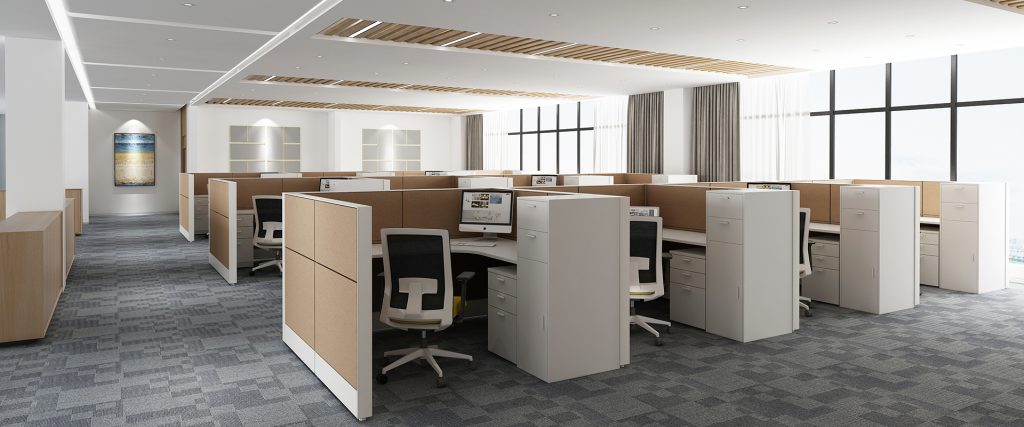
The Ultimate Procurement Guide to Partition Workstations: A Comprehensive Deep Dive into Dimensions, Materials, and Global Standards (2026 Edition)
Author: Xinda Clover
Say Goodbye to Noise and Chaos! Commercial-grade procurement experts teach you how to select modular workstation systems that stand the test of time based on your budget, headcount, and office aesthetics.
Overcoming Distractions in an Open-plan Office
Have you ever found yourself completely derailed at work by a coworker’s loud phone calls or the relentless clacking of keyboards? With nowhere to rest your eyes and no barrier to block out distractions, maintaining focus feels impossible. This is a common plague of modern workplaces. Studies consistently show that environmental noise and visual interruptions are primary culprits behind lost productivity.
Enter the partition workstation. It is far more than a simple physical divider; it acts as an employee’s “personal productivity shield.” Through intelligent acoustic design and spatial planning, it effectively boosts concentration and mitigates distracting background noise. Today, we aren’t here to pitch flashy marketing gimmicks. We are focusing purely on hard facts based on commercial engineering standards to help you avoid low-quality traps and build a truly high-performance workspace.
Today, bypassing superficial gimmicks, we dive straight into hard-core, commercial-engineering standards. This guide will help you steer clear of low-cost, inferior products and build a genuinely high-efficiency workplace.
Decoding Core Parameters: Optimizing Your Partition Workstation Layout
Determining the ideal footprint and height is your first procurement hurdle. It dictates not only office aesthetics but also office ergonomics and traffic flow.
Standard Desktop Dimensions for an Office Cubicle Staff Workstation
Single, face-to-face, or multi-person layouts must strictly adhere to commercial standard dimensions. To achieve maximum office layout efficiency, the standard length for a single-user desk typically ranges from 1200mm to 1400mm, with a depth between 600mm to 800mm. This footprint comfortably accommodates essential office hardware while leaving ample room for under-desk cable routing. Multi-person hubs are then built by seamlessly interlocking these modular configurations.
How to Choose the Right Height for Your Partition Workstation
Low Screens (<1200mm): Ideal for creative departments or teams requiring frequent communication. They provide basic visual boundaries while maintaining an airy, open feel for seamless collaboration.
Medium Screens (1200-1500mm): The versatile “sweet spot” for most businesses. They perfectly block line-of-sight when employees are seated to ensure privacy, yet allow them to see colleagues when standing up, striking a balance between focus and connection.
High Screens (>1500mm): Tailored for roles demanding deep concentration, such as finance, programming, or executive offices. They virtually eliminate peripheral visual distractions, creating a private, “silent pod” atmosphere.
Avoiding Traffic Flow Pitfalls
Many procurement managers only calculate the workstation’s footprint while neglecting aisle clearance. To account for ergonomic chair recline and daily foot traffic, main corridors must maintain a minimum clearance of 90cm, and secondary aisles should not be less than 75cm. This prevents the suffocating feeling of an overcrowded layout.
Hardcore Material Breakdown: Prioritizing Longevity and Texture
The craftsmanship of the frame and panels directly dictates the service life and premium feel of the modular network.
1. Panel Materials: Striking the Balance Between Aesthetics and Functionality
Acoustic Fabric Panels: The ultimate choice for sound control. High-quality, double-sided woven linen fabrics offer a refined tactile feel, inherit excellent flame retardancy and stain resistance, and effectively absorb mid-to-high frequency ambient noise.
Melamine Faced Chipboard (MFC): The king of ROI (Return on Investment). Featuring a scratch-resistant, wear-resistant, and easy-to-clean surface with a vast array of wood grain textures, it is ideal for high-traffic, heavy-use office zones.
Tempered Glass: Minimalist and translucent. It allows natural light to penetrate freely, making it perfect for darker workspaces with limited window access. Pro-tip: Since its acoustic insulation is relatively weak, pairing it with frosted film is highly recommended to enhance privacy.
2. The Frame Showdown: 6063-T6 Aluminum Profiles vs. Industrial Steel Frames
This is the ultimate watershed differentiating high-end contract furniture from low-end alternatives.
6063-T6 Aluminum Profiles (Highly Recommended): If you anticipate rearranging your office layout in the future, or if your facility is located in humid tropical regions, aviation-grade 6063-T6 aluminum alloy is a non-negotiable specification for a modern office partition workstation. Weighing only one-third of conventional steel, it reduces building dead load and simplifies teardown and reconfiguration. More importantly, premium aluminum treated with anodization or powder coating never rusts, keeping your asset looking brand new for decades. While the initial procurement cost is slightly higher, its value becomes clear when calculated over a 10-year depreciation lifecycle.
Industrial Steel Frames (Niche Scenarios): Their primary advantages lie in extreme structural rigidity and a lower initial price point. However, the drawbacks are immense: heavy weight, difficult relocation, and high long-term maintenance. If the anti-rust pre-treatment is substandard, steel will corrode and deform in humid environments. They are only recommended for factory floor offices or strict budget scenarios where relocation is completely ruled out.
Acoustic Engineering: Building a Quiet Focus Zone
True sound isolation relies on the “Law of Mass” combined with “Acoustic Infill.” Thicker panels block sound transmission paths, while internal sound-absorbing cores dissipate sound energy to maximize acoustic insulation.
20mm–45mm Thickness (Basic Zoning): Primarily serves as a visual boundary. It offers basic acoustic dampening and is best suited for budget-conscious startups or collaborative teams.
60mm Thickness (Commercial Standard): The mainstream contract furniture benchmark. Stuffed with high-density polyester fiber or rock wool insulation, it effectively dampens daily conversational noise, making it the staple choice for operational departments to improve overall employee focus.
75mm–83mm Thickness (Deep Silence Grade): Engineered with a multi-layered composite acoustic structure. Specifically tailored for telemarketing centers, conference zones, or executive suites, delivering near “acoustic capsule” privacy.
Global Market Adaptability: Tailoring Sourcing Strategies by Region
Diverse workplace cultures and distinct climate conditions necessitate localized partition workstation configurations. As a leading player in the global supply chain, we summarize the ideal regional setups below:
Southeast Asia, Africa, & Latin America: Characterized by hot, humid climates where rapid installation and high cost-efficiency are prioritized. We recommend 20mm–45mm lightweight, slimline profile systems paired with high-grade moisture-resistant core boards to optimize overall project expenditures.
The Middle East: A market that favors corporate prestige, heavy-duty configurations, and moderate privacy. The 60mm thickness system is the ideal fit here, perfectly balancing business texture with solid sound insulation, matching local commercial aesthetics.
North America & Australia: Stringent demands for absolute privacy, premium weight, and rigorous green certifications. We recommend 60mm–83mm heavy-duty configurations packed with multi-layered acoustic materials. Products must comply with ANSI/BIFMA structural test standards and satisfy low-VOC emission laws (such as E0 or GREENGUARD standards).
Commercial Sourcing Bottom Line: Certifications and Red Flags
Health compliance and structural safety are the absolute baselines for commercial office furniture. When evaluating factory quotations, always demand the following verification documents from your vendor:
Environmental Standards: Ensure all engineered wood substrates meet E0 or E1 certification limits to guarantee minimal volatile organic compound (VOC) emissions, protecting your employees’ respiratory health.
Structural Stability: Products must successfully pass authoritative international compliance tests like BIFMA X5.1. Reject cheap alternatives that wobble or shake with a simple push.
Beware of Cut Corners: Steer clear of ultra-low-priced suppliers utilizing recycled scrap aluminum, ultra-thin sheet iron, or those lacking accredited environmental lab reports. These hidden liabilities typically trigger massive structural failures within six months of deployment.
FAQ: Frequently Asked Questions
Q1: Do fabric partitions get dirty easily? If choosing fabric, opt for stain-treated or removable/washable options. For maximum peace of mind, matte melamine boards are practically maintenance-free.
Q2: How do I furnish a small office? Opt for light color palettes (e.g., misty grey, white oak) paired with slim-profile screens. Incorporating transparent glass elements strategically can visually maximize the perceived space.
Q3: Is installation complicated? Modern partition workstations use modular hardware connectors and feature adjustable leveling feet to accommodate uneven floors. Professional installers can typically assemble them in half a day, and some lightweight models even support DIY assembly.