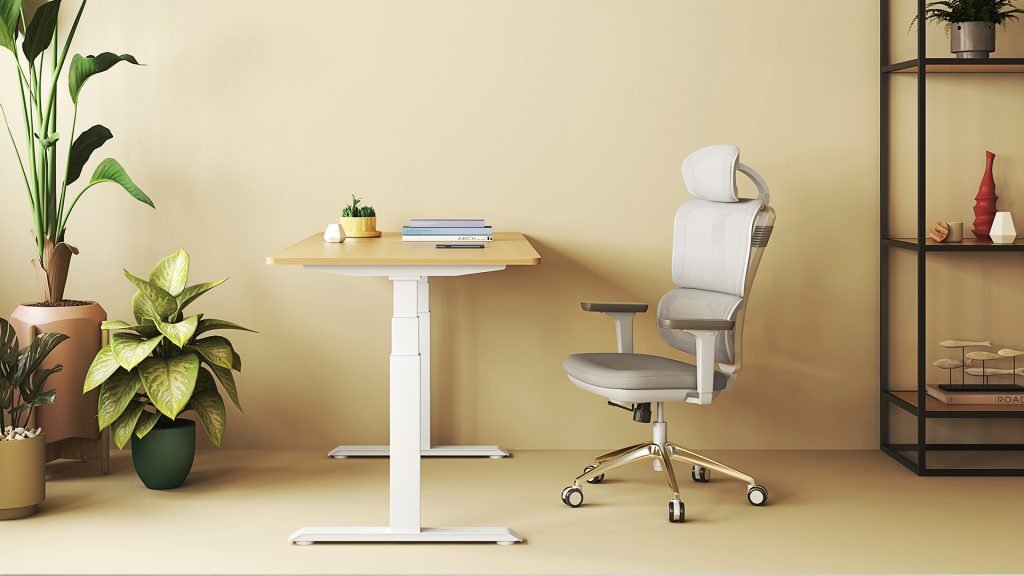
Best Standing Desk for Home Office: The Complete Buyer’s Guide (2026)
Author: Xinda Clover
The modern remote workspace requires verifiable ergonomic integration. As professionals globally transition to long-term work-from-home (WFH) models, deploying the best standing desk for home office environments has evolved from a basic furniture preference into a strict health-and-performance requirement.
According to global ergonomic procurement standards, a certified variable-height workstation must deliver precise mechanical stability, low acoustic disruption, and strict chemical safety. This analytical guide bypasses generalized marketing claims to present the exact engineering metrics required to select a commercial-grade, health-compliant standing desk for your home infrastructure.
Why Height-Adjustable Desks Are Essential for Modern Professionals
The proliferation of standing desks is driven by their precision in resolving the critical liabilities inherent in traditional fixed-height furniture:
1. Alleviating Spinal & Lumbar Pressure: Alternating between sitting and standing unloads vertebral stress, actively stimulating blood circulation while optimizing digestive and metabolic functions.
3. Personalized Anthropometric Adaptation: Digital lifting systems offer precise customization to meet the exact ergonomic requirements of any user, regardless of stature.
4. Maximizing Spatial Utility: A versatile standing desk seamlessly transitions into an impromptu standing meeting hub or a temporary high-top workstation, drastically enhancing real estate efficiency.
For all home office remote workers, a height-adjustable standing desk is a cost-effective ergonomic investment that relieves back pain, corrects poor posture and delivers measurable improvements to long-term WFH productivity and physical wellness
1. Technical Benchmarks of a High-Fact Density Standing Desk
The long-term performance of a height-adjustable desk is primarily determined by three key factors: structural integrity, load-bearing capacity and material safety. Below is a detailed breakdown of the specific technical parameters and international certifications that validate these qualities.
Motor Synchronization and Dynamic Load Capacity
Single-motor systems are prone to uneven lifting and premature drive failure under asymmetrical loads. Therefore, the best standing desk for home office deployments utilizes a synchronized dual-motor lifting system.
Dynamic Load Limit: Minimum 120kg (264 lbs) lifting capacity to accommodate multiple enterprise monitors, heavy CPU mounts, and desktop peripherals.
Structural Stability: Heavy-duty carbon steel telescoping legs (minimum 2.0mm frame thickness) to eliminate lateral wobble at maximum extension (>1200 mm).
Maximum Noise Level: ≤ 45 dB during active transition (whisper-quiet commercial standard).
Adjustment Velocity: Minimum 32mm/s linear travel speed with micro-smooth start-and-stop dampening to protect desktop liquid containers from spilling.
Smart Programmable Logic Controllers (PLC)
A premium home office standing desk must adopt a dual-motor synchronous drive, support a 120kg minimum load capacity, keep operation noise below 45dB and include multi-height memory presets to balance stability, quiet operation and user convenience.
2. XINDA CLOVER Standing Desk Matrix
At XINDA CLOVER, our 36-year manufacturing infrastructure translates heavy-duty commercial office engineering into specialized work from home furniture.
Technical Parameter
XINDA CLOVER Engineering Standard
Drive System Frame Material Certification Standard Tabletop Core Formaldehyde Emission Safety Mechanism
With BIFMA X5.5 structural certification, EN 717-1 formaldehyde emission compliance and positive user review data, the XINDA CLOVER standing desk is a reliable commercial-grade option balancing structural durability, chemical safety and real-world user satisfaction.
Deploy a streamlined 1200mm * 600mm dual-motor configuration. Ultimately, this saves floor footprint while preserving full vertical travel ranges (620mm – 1270mm). The built-in basic cable management slots organize power cords and data lines to keep small workspaces tidy.
Executive Multi-Screen Hubs (>120sq ft):
Deploy an expansive 1600mm * 800mm heavy-duty ergonomic desk, engineered with built-in dual-slot cable management trays to cleanly route complex data and power architectures for multi-monitor setups, desktop hosts and various office peripherals. The upgraded cable management system fully eliminates messy wire tangles and optimizes workspace order.
Choose desk dimensions based on your home office square footage, use the 30-30 sit-stand rule for healthy posture rotation, and leverage integrated cable management to create a neat, ergonomic and high-efficiency remote working environment.
4. Frequently Asked Questions:
1. Q: Why is BIFMA compliance critical for a home office standing desk?
A: BIFMA X5.5 certification ensures the desk has successfully passed over 20,000 cycles of rigorous load, tip, and structural fatigue testing, verifying long-term durability and daily use safety. You can view official standard details via the BIFMA official website.
2. Q: How does a dual-motor system protect sensitive home office electronics?
A: Dual-motor engineering provides independent, real-time torque compensation to each desk pillar. Combined with our integrated gyroscopic anti-collision sensor, the system instantly halts and reverses movement if it detects a physical obstruction, protecting hardware from structural impact.
3. Q: What sit-stand ratio works best to relieve back pain for WFH users?
A: Cable management is essential for multi-screen workstations. Dedicated cable trays organize power cables, video lines and peripheral wires, preventing wire entanglement, tripping hazards and damage to electronic devices, while also keeping the workspace clean and orderly.
4. Q:Are low-formaldehyde tabletops necessary for home office standing desks?
A: Cable management is essential for multi-screen workstations. Dedicated cable trays organize power cables, video lines and peripheral wires, preventing wire entanglement, tripping hazards and damage to electronic devices, while also keeping the workspace clean and orderly.
5. Q: Are low-formaldehyde tabletops necessary for home office standing desks?
Absolutely. Desktops meeting EN 717-1 standards with formaldehyde emission ≤ 0.5 mg/L release nearly no harmful VOCs. This protects indoor air quality, which is especially vital for users who work 8+ hours daily in enclosed home office spaces.
Final Review
In conclusion, selecting the best standing desk for home office application requires a deep look at verified engineering data: from BIFMA structural ratings to E0 chemical emission safety. Partnering with a proven commercial manufacturer guarantees your home setup operates with the exact same durability as a fortune 500 corporate headquarters.
Contact the XINDA CLOVER engineering team today to download our full product CAD blocks, view verified test certifications, or request a volume manufacturing quotation for your distributed remote workforce.