Strategic ESG Optimization: How Sustainable Office Furniture Drives Supply Chain Decarbonization and Audit ROI
Author: Xinda Clover
Key Takeaways for ESG Auditors
Regulatory Alignment: Standardized environmental data (EPDs) simplifies compliance with CSRD (EU) and SEC Climate Disclosure (US) mandates.
Carbon Accounting: Integration of furniture with low Embodied Carbon (EC) directly lowers Scope 3 emissions under ISO 14064-1 frameworks.
Material Compliance: Prioritize materials with FSC certification and LEED v4.1 Low-Emitting Materials status (Formaldehyde ≤0.5mg/L per EN 717-1).
Asset Durability:BIFMA LEVEL® certified furniture ensures a 10+ year lifecycle, reducing replacement frequency and associated procurement waste by 40%.
In the 2026 corporate landscape, sustainability has shifted from a marketing elective to a core procurement mandate. For ESG Auditors, Facility Managers, and Architects, the selection of commercial office furniture is a critical lever for optimizing Corporate Social Responsibility (CSR) ratings and ensuring supply chain transparency. This guide analyzes how certified sustainable furniture acts as a strategic asset in achieving Net Zero goals and maximizing investment returns.
1. Material Selection: The Foundation of Supply Chain Compliance
Sustainable procurement begins at the molecular level. For a high-performance ESG rating, furniture must be audited against verifiable material standards.
Sustainable Material Performance Matrix
Material Type
Sustainability Standard
Impact on ESG Rating
Compliance Metric
Wood Panels (MFC/MDF)
FSC (Forest Stewardship Council)
Prevents deforestation-linked Scope 3 emissions
100% Traceability to managed forests
Aluminum Frames
ISO 14021 (Recycled Content)
Reduces Embodied Carbon by 95% vs virgin metal
100% Infinitely recyclable with zero loss
Textiles & Fabrics
Global Recycled Standard (GRS)
Diverts post-consumer ocean plastics from landfills
Weight-based recycled content percentage
Powder Coatings
VOC-Free (Volatile Organic Compounds)
Improves Indoor Environmental Quality (IEQ)
≤0.5mg/L Formaldehyde (EN 717-1)
2. Supply Chain Decarbonization & Audit Gains
Integrating sustainable furniture isn’t just about the product; it’s about the data trail. High-authority ESG ratings are built on verified benchmarks.
ISO 14001 Integration: Sourcing from an ISO 14001 certified facility like Clover Furniture ensures that the manufacturing process itself minimizes waste and resource depletion, providing a pre-audited supply chain layer for your corporate report.
LEED & WELL Certification Points: Selecting furniture that meets LEED v4.1 (Low-Emitting Materials) and BIFMA LEVEL® standards can contribute up to 10 points toward green building certifications, directly increasing the market value of the commercial real estate asset.
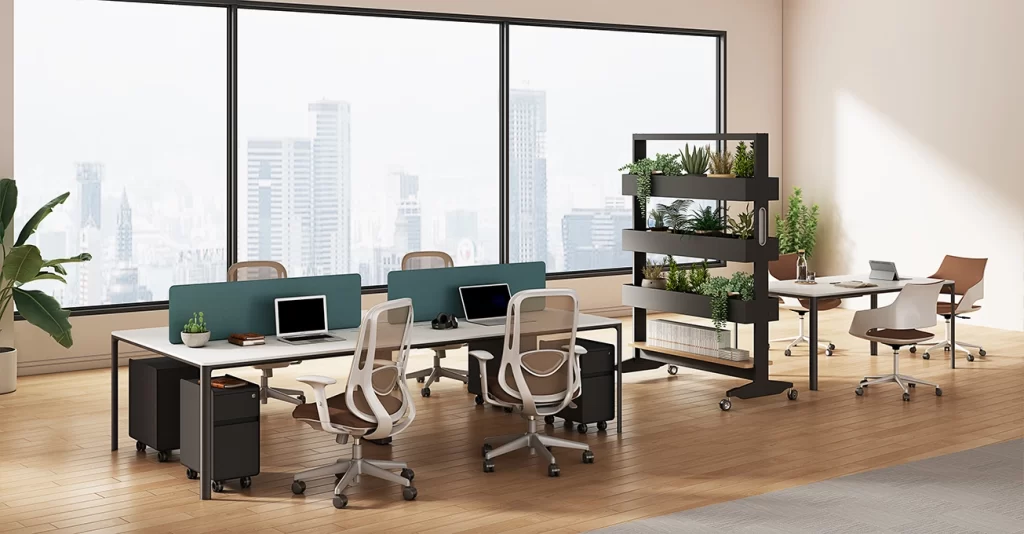
Circular Economy Alignment: Modular furniture systems (such as our Desk & Table Systems) support a circular model where components are reused or refurbished rather than landfilled, directly fulfilling the “Circular Economy” reporting requirements of modern ESG frameworks.
3. The ROI of ESG: Beyond Compliance to Asset Value
Sustainability is a driver of long-term financial performance.
Reduced Operational Risk: Compliant materials (BIFMA X5.5/X5.9) reduce the risk of safety-related workplace claims and liability.
Enhanced Talent Acquisition: According to recent workplace studies, 70% of employees are more likely to stay with a company that has a strong environmental record.
Capital Access: Modern institutional investors prioritize companies with high ESG scores, often resulting in lower borrowing costs and higher stock valuations.
Transform Your Workspace Today
A sustainable workplace is no longer optional—it is the baseline for future-proof enterprises. By partnering with XINDA CLOVER, you secure premium corporate aesthetics while actively driving global waste reduction.
Ready to upgrade your enterprise environment with verified eco-friendly materials?
Contact the XINDA CLOVER B2B sales team today to request our 2026 sustainable product catalog and wholesale green quotes.
Q: How does Clover Furniture support Scope 3 emission reporting?
A: We provide granular data on material composition and sourcing (e.g., FSC lumber, recycled aluminum). This data allows ESG auditors to calculate Embodied Carbon (EC) accurately using ISO 14064-1 protocols, providing the transparent evidence required for SEC and CSRD climate disclosures.
Q: Does sustainable furniture meet the same durability standards as traditional furniture?
A: Yes. In many cases, it exceeds them. All Clover sustainable product lines are engineered to meet or exceed ANSI/BIFMA X5.5 (Desk) and X5.9 (Storage) standards. Our use of high-grade 6063-T5 aluminum alloys ensures a structural lifecycle exceeding 10 years, which is a key metric for “Long-term Value” in ESG audits.
Q: How do low-VOC materials impact the WELL Building Standard?
A: Furniture that adheres to EN 717-1 (Formaldehyde emission ≤0.5mg/L) directly contributes to the “Air” and “Materials” concepts of the WELL Building Standard. By eliminating toxic off-gassing, these materials improve indoor air quality, which has been linked to an 8-11% increase in cognitive performance and reduced employee absenteeism.
Q: Can modular furniture be audited as a “Circular Asset”?
A: Absolutely. Under the Ellen MacArthur Foundation’s circularity principles, modular workstations that can be reconfigured or upgraded (rather than replaced) qualify as circular assets. Clover’s unitized benching systems allow for 100% component reusability, which significantly improves the “Waste & Resource Management” score in an ESG audit.
Engineering Your Sustainable Headquarters
A future-proof office is built on verified performance and strategic sourcing. By choosing Clover Furniture, you align your workspace with global decarbonization goals while securing a premium, high-performance environment.