Mastering Open Office Design: Furniture for Better Teamwork
Author: Xinda Clover
Modern workplace strategy has moved beyond the simple “open floor plan.” Today, a successful open office design is a deliberate tool used to drive faster project cycles and higher engagement. The challenge, however, isn’t just removing walls—it’s providing an infrastructure that supports movement without losing the high-tech connectivity teams need to function.
At XINDA CLOVER, we developed the EPO Series to bridge this gap. As a modular, power-integrated system, EPO acts as the invisible “engine” for a modern collaborative office space, solving the logistics of power distribution while maintaining a clean, professional aesthetic.
Why Strategic Open Office Design Matters
Collaboration is often spontaneous. It happens at a desk, in a hallway, or over coffee. Research indicates that a well-executed collaborative office space can boost productivity by up to 20% by facilitating these “planned collisions.”
The risk of an open office design, however, is the “noise trap”—where openness leads to distraction. The goal is to create distinct zones: high-energy areas for huddles and quiet corners for deep focus. The furniture you choose is the only thing that makes these zones work.
3 Furniture Ideas to Transform Your Open Office Design
A successful open office design balances individual focus, team collaboration, and flexibility. Here are the essential furniture elements, elevated by the EPO series:
1. Modular Workstations with Integrated Power
The biggest “tether” in an office is the wall outlet. If your desks are stuck to the wall, your open office design is frozen.
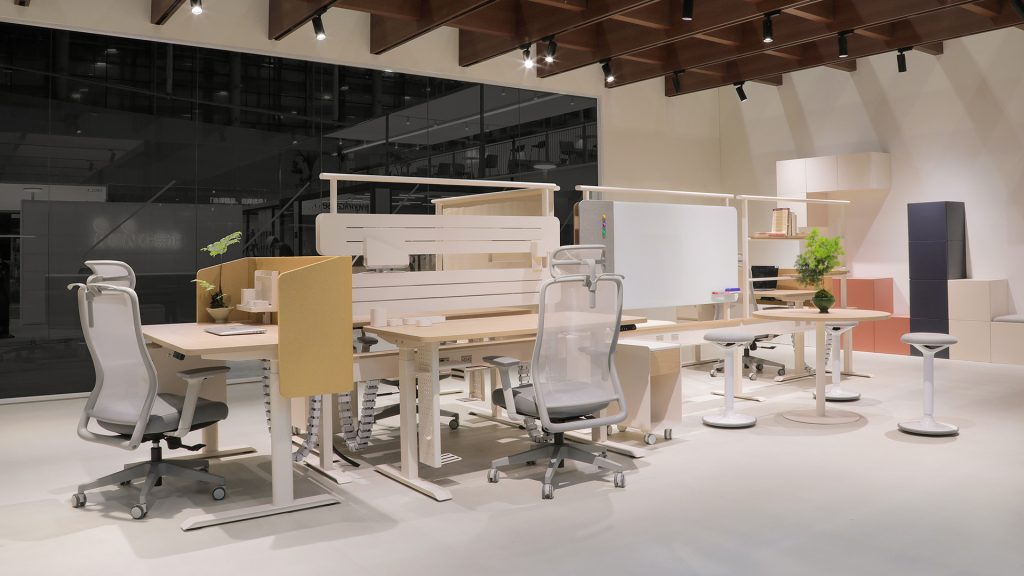
The EPO Solution: Our system uses a daisy-chain power spine. It allows you to link multiple workstations together from a single power source.
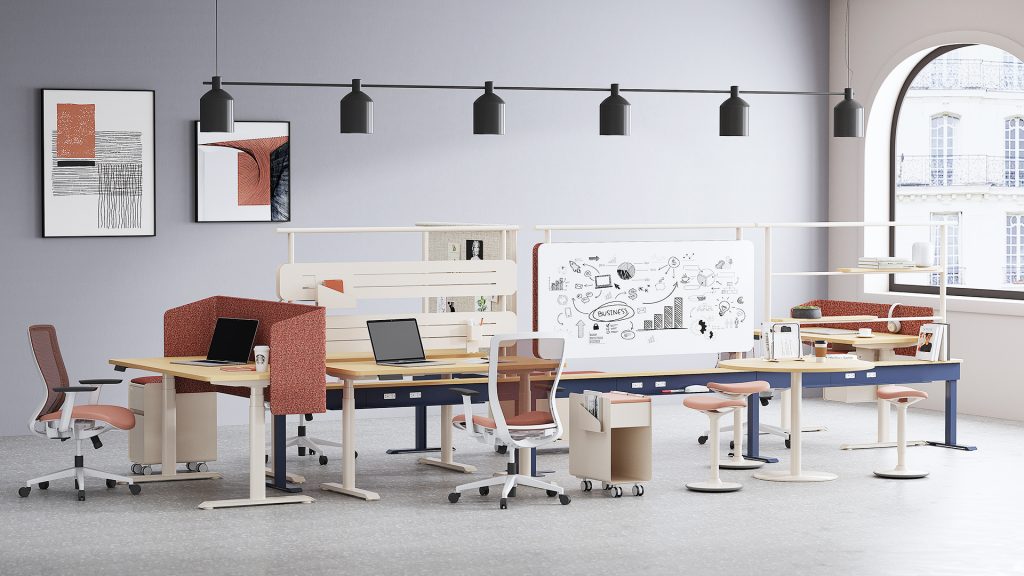
Sit-Stand Ready: EPO integrates seamlessly with height-adjustable desks. The vertical “cable snake” manages wires during height transitions, keeping the collaborative office space tidy and hazard-free. This mobility is a primary reason the system is a top-seller in the U.S. market.
2. Strategic Partitions: Privacy without Isolation
A common mistake in open office design is a total lack of privacy. EPO solves this with modular partitions that provide visual and acoustic relief:
Fabric & Acoustic Panels: These absorb ambient noise, allowing for focused work within a busy room.
Aesthetic Cohesion: Unlike bulky traditional cubicles, these partitions maintain a slim profile that keeps the office feeling airy and modern.
3. Integrated Team Meeting Furniture
When inspiration strikes, you shouldn’t have to hunt for a conference room. The EPO series brings the meeting to you.
Mobile Writing Surfaces: We’ve integrated whiteboards directly into the system, turning any workstation into a brainstorming hub.
Huddle Zones: By pairing the power spine with round tables and sleek team meeting furniture, you create informal zones for quick check-ins.
The “Resimercial” Detail: The addition of wooden trays for laptops and coffee mugs adds a touch of warmth—perfect for the “resimercial” (residential + commercial) trend currently dominating American offices.
Why the EPO Series is Winning in the U.S. Market
The U.S. market demands agility. With the rise of hybrid work, companies need to reconfigure their floor plans in hours, not weeks.
Zero-Downtime Reconfiguration: Because of the plug-and-play power system, teams can reorganize their layout without calling an electrician.
Durability & Compliance: Built with high-strength steel and scratch-resistant finishes, EPO meets the rigorous standards required by fast-growing tech startups and corporate headquarters alike.
Real-World Success: The EPO Series in Action
Case Study 1: San Francisco Tech Startup
A 50-person SF startup struggled with a rigid layout that hindered their collaborative, hybrid workflow. We installed the EPO series: 30 modular workstations, 5 team pods, and team meeting furniture. The result? 25% higher productivity, 30% better employee satisfaction, and a workspace that attracts top Bay Area talent.
Case Study 2: Chicago Corporate Office
A Fortune 500 company renovated 10,000 sq. ft. for hybrid work (60% in-office, 40% remote). The EPO series provided 80 modular workstations, mobile whiteboards, and informal collaboration zones. They saw 20% lower space costs and 25% more cross-departmental collaboration.
How to Implement Your Collaborative Office Space
Audit Your Workflow: Do your teams spend more time on “deep work” or “huddles”? Adjust the ratio of partitions to open tables accordingly.
Define the Zones: Use EPO power spines to create “islands” for different departments, separated by informal coffee tables.
Choose Flexibility: Opt for team meeting furniture that can be moved or repurposed as your team grows.
Avoid These Common Open Office Design Mistakes
Ignoring Cable Management: Tangled wires ruin the look of a modern office and create trip hazards.
Sacrificing Quiet Zones: Always use acoustic partitions to give employees a place to focus.
Static Layouts: Ensure your furniture can adapt. A collaborative office space that can’t change is just a cubicle farm without walls.
A high-performing collaborative office space starts with the right infrastructure. The EPO series—with its modular flexibility, integrated power, and specialized team meeting furniture—is designed to grow with your business.
Ready to rethink your floor plan? Download our EPO Series catalogue or contact us at info@xdo.com.cn for a custom space-planning consultation. Let’s build an open office design that actually moves your business forward.